
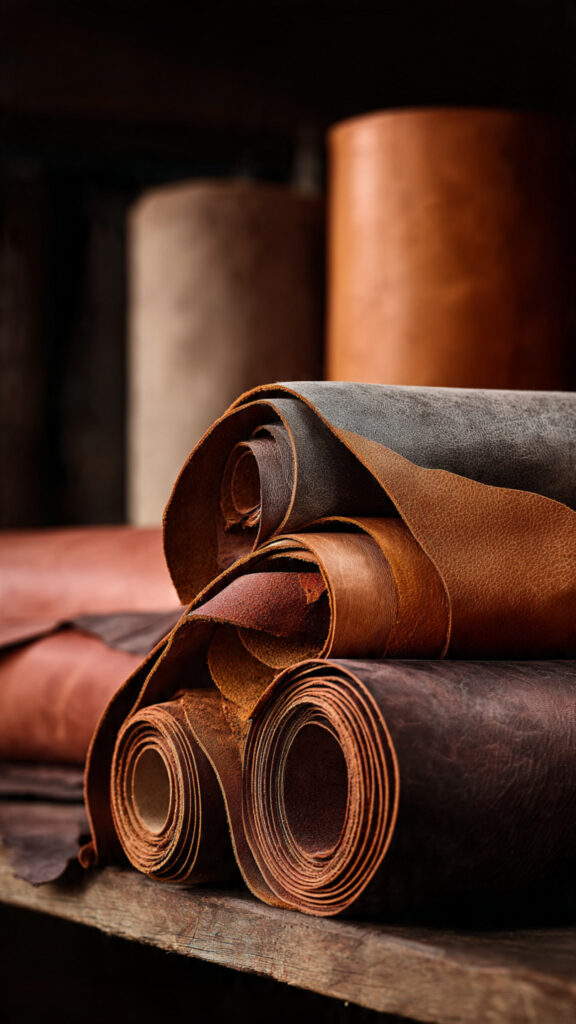
When we touch a piece of leather, one of the first characteristics we notice is its hand feel. Some leathers feel firm, structured, and substantial, while others feel soft, flexible, and lighter to the touch.
But why does this happen?
The answer does not depend on a single factor. The firmness or softness of leather is the result of a combination of fiber structure, tanning method, thickness, post-tanning processes, and the way the material is conditioned and dried.
In other words, the way leather feels in our hands is the result of an entire process.
Fiber Structure: The Starting Point
Leather retains a fibrous collagen structure that comes from the hide. During its transformation, this structure undergoes different treatments designed to stabilize the fibers and give the material the properties required for its final use.
The way these fibers are organized and interact with one another directly influences characteristics such as flexibility, body, drape, and final hand feel.
That is why two leathers can look similar while feeling completely different when touched.
Modern leather manufacturing combines traditional knowledge with technical controls to modify these characteristics according to the desired result.
The Tanning Method Also Makes a Difference
Tanning is one of the fundamental stages in leather manufacturing. Its main purpose is to stabilize the fiber structure and transform the hide into a durable and usable material.
There are different tanning systems, and each can contribute particular characteristics.
In the case of vegetable-tanned leather, tannins derived from plant sources are used. This type of tanning generally requires more time and is known for developing distinctive characteristics in the leather’s appearance and hand feel, as well as an aesthetic that can evolve through use and over time.
This helps explain why not all leathers have the same feel: the tanning method is part of the material’s physical and aesthetic identity.
Thickness: More Body Does Not Always Mean More Rigidity
Another important factor is leather thickness, also known as substance.
A thicker leather may provide greater body and structure, while a thinner leather may feel more flexible. However, thickness alone does not completely determine softness.
During manufacturing, operations such as splitting and shaving can also be performed to achieve a specific thickness and greater uniformity.
Therefore, when evaluating the final feel of leather, it is important to consider the combination of its characteristics rather than thickness alone.
What Role Do Oils and Softening Processes Play?
Here we find one of the most interesting factors.
During leather manufacturing, products known as fatliquors may be used to lubricate the leather fibers.
These products can penetrate the fibrous structure and provide lubrication. Their penetration and the amount used can influence the final softness of the leather.
This means that softness does not simply happen because leather is “left for longer” or because it comes from a particular hide. It is the result of technical decisions made throughout different stages of production.
Drying Also Changes the Final Result
After processes such as tanning, retanning, and fatliquoring, leather goes through different operations to remove water and dry the material.
These stages are particularly important because they can affect fiber orientation.
Mechanical operations performed before drying can significantly influence the fibrous structure and, consequently, characteristics such as softness, grain break, and overall uniformity.
That is why even after the tanning process is complete, leather still has important stages ahead before reaching its final characteristics.
So, Is Firm Leather Better Than Soft Leather?
Not necessarily.
Firmness and softness are not a matter of “better” or “worse.” They depend on the characteristics required for the final product.
A leather with greater body may be suitable for products where structure and dimensional stability are desired. On the other hand, softer leather may be appropriate when flexibility, comfort, or a particular drape is important.
The key is finding the right balance between hand feel, structure, strength, flexibility, thickness, and appearance.
Leather’s Character Lies in the Details
One of the unique characteristics of leather is that its behavior does not depend on a single formula.
The raw material has a natural fiber structure, and from there, tanning, retanning, fatliquoring, dyeing, drying, and finishing processes help develop different characteristics.
In vegetable-tanned leather, the tanning method can also contribute to a distinctive appearance and hand feel that evolves over time.
That is why when we talk about leather, describing it as “soft” or “firm” is only the beginning. Behind that sensation is a combination of raw material, technical knowledge, time, and precision.
From Tradition to Precision
Modern leather manufacturing shows that tradition and technology do not have to be separate.
Traditional processes contribute knowledge and experience accumulated over generations, while modern controls make it possible to monitor variables such as pH, moisture, dosage, and product absorption to achieve more consistent results.
In a finished piece, all of this becomes something we can immediately perceive: how the leather feels in our hands.
And perhaps that is one of the most fascinating things about this material: behind a soft texture or a firm structure lies an entire process of transformation.
At Marfil Tannery, we believe quality can also be felt.
Every characteristic of leather is connected to a process in which experience, precision, and knowledge of the material are essential.
Because before becoming a finished product, leather goes through a journey in which every stage contributes to defining its character.
Firmness can be felt. Softness can be felt too. But behind both lies a story of process, knowledge, and dedication.
Reference Sources
- Leather Working Group. Making Leather – Overview.
- Leather Working Group. How Modern Leather Is Made.
- Leather Working Group. Essential Leather Industry Terms.