
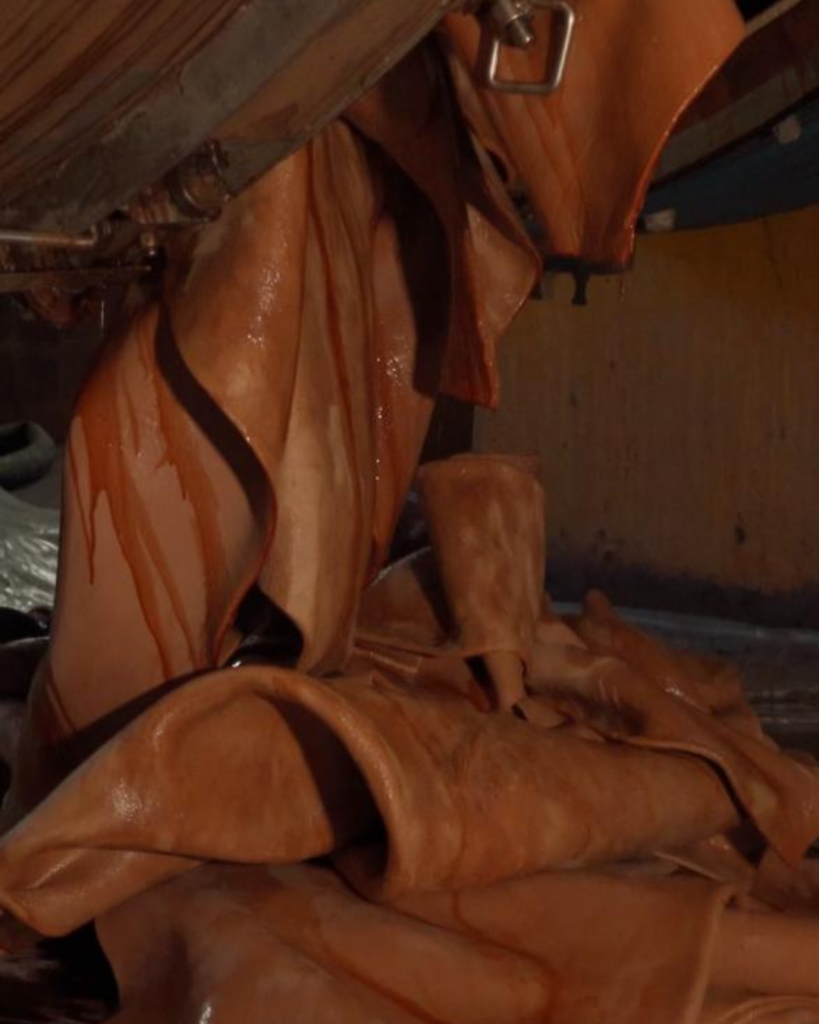
León, Guanajuato, cannot be understood without leather. For generations, this material has been part of the city’s industrial identity, supporting jobs, businesses and knowledge passed from one generation to the next.
But behind every piece of leather lies a much broader story: the story of a city that transformed a craft into an industry, of thousands of people who perfected techniques over time, and of a tradition that has learned to evolve without losing its essence.
From Traditional Crafts to a Recognized Industry
León’s relationship with leatherworking dates back to the early centuries of the city’s development. The availability of water and the region’s livestock activity favored the growth of activities related to leather processing.
Over time, workshops dedicated to tanning and leather goods became an important part of León’s economic landscape. What began as small-scale artisanal trades gradually developed into a much broader and more complex production chain.
The growth of the leather industry was also closely connected to another activity that would become one of León’s most recognizable industries: shoemaking.
Local tanneries provided manufacturers with different types of leather for producing shoes, belts, bags, gloves and other leather goods. This helped establish a relationship that continues today: tanning and leather manufacturing grew together.
The Talent Behind Leather
Talking about León’s leather industry means talking about much more than machinery, processes and facilities.
It means talking about people.
Tanners, leather selectors, operators, craftsmen, designers, manufacturers and specialists have built knowledge over decades that cannot be learned solely from a manual.
Working with leather requires understanding its behavior, recognizing its natural characteristics and knowing how it responds to different processes.
Experience allows specialists to identify details that may go unnoticed when looking only at the finished product: variations in grain, differences in texture, natural marks or the way a hide may react during tanning.
That knowledge is part of León’s industrial heritage.
And this is precisely where one of the industry’s greatest strengths lies: the combination of traditional knowledge and the ability to adapt.
An Industry That Learned to Evolve
The leather industry has changed considerably over time.
Today’s markets demand greater consistency, new finishes, more efficient processes and stronger environmental responsibility. Brands and consumers are also increasingly interested in knowing where the materials they use come from.
This means that tradition alone is no longer enough.
The real challenge is preserving knowledge passed down through generations while incorporating new technologies and better practices.
In León, this evolution can be seen in the modernization of production processes, resource optimization systems, wastewater treatment, renewable energy and new approaches to using resources more efficiently.
Innovation does not necessarily mean abandoning what has been done for decades.
In many cases, it means finding better ways to do it.
Leather and the Circular Economy
There is an important conversation surrounding the leather industry: where does leather come from?
In a large part of global leather production, the hides used by the industry are a by-product of the meat industry. In other words, animals are generally not raised exclusively for their hides.
Using this material allows it to re-enter a production chain and be transformed into a long-lasting product.
When leather is used to manufacture products that can accompany people for years—such as footwear, belts, bags and accessories—the useful life of the material can be significantly extended.
That is why discussing responsible production requires going beyond simply calling a product “natural” or “sustainable.” We need to consider where the material comes from, how it is processed, what resources are used, how waste is managed and how long the final product can remain in use.
León: A Tradition Looking Toward the Future
Today, León is internationally recognized for its footwear industry and for the broader production ecosystem connected to leather.
The importance of this industry is not measured only through economic figures.
It can also be found in the knowledge it preserves, the jobs it creates, the family businesses passed from one generation to another, and the identity built around this craft.
For companies such as Marfil Tannery, being part of this history represents a responsibility: continuing to develop leather using knowledge accumulated over decades while responding to today’s challenges and expectations.
Tradition becomes truly meaningful when it can evolve.
The Value of Doing Things with Knowledge
In a time when many industries are focused on producing faster and faster, leather reminds us that certain materials require time, experience and attention to detail.
Every hide has its own characteristics. Its texture, structure and behavior can vary, and that natural character is precisely part of what makes leather unique.
A tannery’s role is to transform this raw material into a functional, durable material suitable for different applications.
In 100% vegetable-tanned leather, for example, plant-derived tannins are used to stabilize the hide and give it distinctive characteristics in appearance, feel and aging.
The result is not simply a material.
It is the combination of raw material, knowledge, time, technique and experience.
More Than an Industry: An Identity
The story of León and leather is, ultimately, a story about people.
It is the story of those who began working in small workshops, those who learned a trade from their families, those who introduced new technologies and those who continue searching for better ways to produce.
It is also the story of a city that built an industrial identity around a material.
So, when we look at a finished leather product, it is worth remembering that there is much more behind it than a surface.
There is a chain of knowledge.
There is work.
There is tradition.
And there is an industry that continues to evolve.
Marfil Tannery: Part of a Tradition That Continues
With more than 40 years of experience, at Marfil Tannery we understand that being part of León’s leather industry means looking back to learn while also looking forward to innovate.
Our commitment to 100% vegetable-tanned leather, continuous process improvement and the pursuit of more responsible practices are part of a vision in which tradition and innovation are not opposites.
They are part of the same story.
Because the future of leather is also built by respecting the knowledge that brought us here.